
SFR-Meshは複数のSFR (Single Frequency Repeater) をメッシュ状に接続し通はセッションを動的に形成する新しいネットワークアーキテクチャです。
現在開発中のシステムで2026年3月より実証実験を開始しました。
SFR-Meshとは
SFR-Mesh は、新たに開発した上位 TG 制御レイヤー(LUTG)を導入し、従来の TG の役割を単なる配信先から「セッション生成トリガー」として再定義します。これにより中央集約型であった TG 制御を各 SFR(Single Frequency Repeater)へ分散し、メッシュ状に接続された通話セッションを動的に形成する新しいネットワークアーキテクチャを実現します。
従来のDMRネットワークでは、通話は主に固定されたトークグループ(TG)に基づいて配信されます。 ユーザーがPTTを押すと、そのTGに接続しているすべてのノードへ音声が配信されます。
この方式はシンプルで広く普及していますが、SFR環境ではいくつかの問題が発生します。
通常、この方式では TGへの接続を維持する必要があります。 しかし、SFRは単一チャネル資源のため、TG接続中はチャンネルが常時接続となり、SFRのリソースを占有してしまいます。 また接続中はローカルの交信トラフィックがそのままネット側に流れてしまいますので公共性が高いSFRでは弊害となります。
自宅に設置されたホットスポットのような環境では大きな問題になりませんが、現在日本で普及している SFR(DMRデジピーター) の運用では次のような制約が生じます。
従来方式の問題
-
TG接続中はSFRリソースが占有される
-
利用できるTGの範囲が制限される
-
不必要なノードにも音声が配信される
-
配信方式のため、TGに複数局が存在しないと交信が成立しない
海外の一般的なDMRリピーター(アップリンク/ダウンリンクの2周波数方式)では、2つの Time Slot を利用して複数のTGを同時に運用することで柔軟性を持たせています。
しかし、日本国内で広く普及している SFR(Single Frequency Repeater) は単一チャネル構成のため、TG運用にはより強い制約があります。
特に大きな制限は、
通信したい相手先のSFRが同じTGに常時接続していない限り、任意のタイミングで交信できない
という点です。
SFR-Meshのアプローチ
SFR-Meshでは、この問題を解決するため通話を「セッション」として管理する方式を採用しています。
ユーザーがPTTを押すと、その通話は単なるトークグループ配信ではなく、特定のノード間で形成される 通話セッションとして処理されます。
この仕組みにより、
-
必要なノードだけに音声を配信
-
SFRリソースの占有を最小化
-
複数の通話を同時に成立
させることが可能になります。
LUTG(Logical Unified Talk Group)
SFR-Meshでは従来のTGを完全に置き換えるのではなく、それらを トリガーとして活用しつつ、新しい論理レイヤーを導入しています。
この論理レイヤーでは LUTG(Logical Unified Talk Group) を使用します。
LUTGはセッションごとに動的に割り当てられる内部TGで、通話のルーティングを制御する役割を持ちます。
接続要求が発生したときのみ、対象となるSFR同士を Peer-to-Peerで接続します。
これにより
-
不要な常時接続を排除
-
必要なときだけ通信路を生成
することができます。
メッシュ型通話セッション
SFR-Meshでは、通話は次のように扱われます。
1つの通話は origin と target のペアとして定義されます。
例
target = TG711108
このペアが成立すると、システム内部で
セッションID(msid) が生成され、同時に LUTG が割り当てられます。
LUTG = 805001
msid = 3
origin = 711111
target = 711108
このセッションは独立して管理されるため、
他の通話セッションとは完全に分離されます。
例えば次のような複数の通話が同時に成立します。
LUTG=805002 Origin:711112 ↔ Target:711109
LUTG=805003 Origin:711112 ↔ Target:711025
つまり、ネットワーク内では 複数の通話セッションが同時に動作します。
音声配信は Origin / Target のペア内でのみ Fan-Out されます。
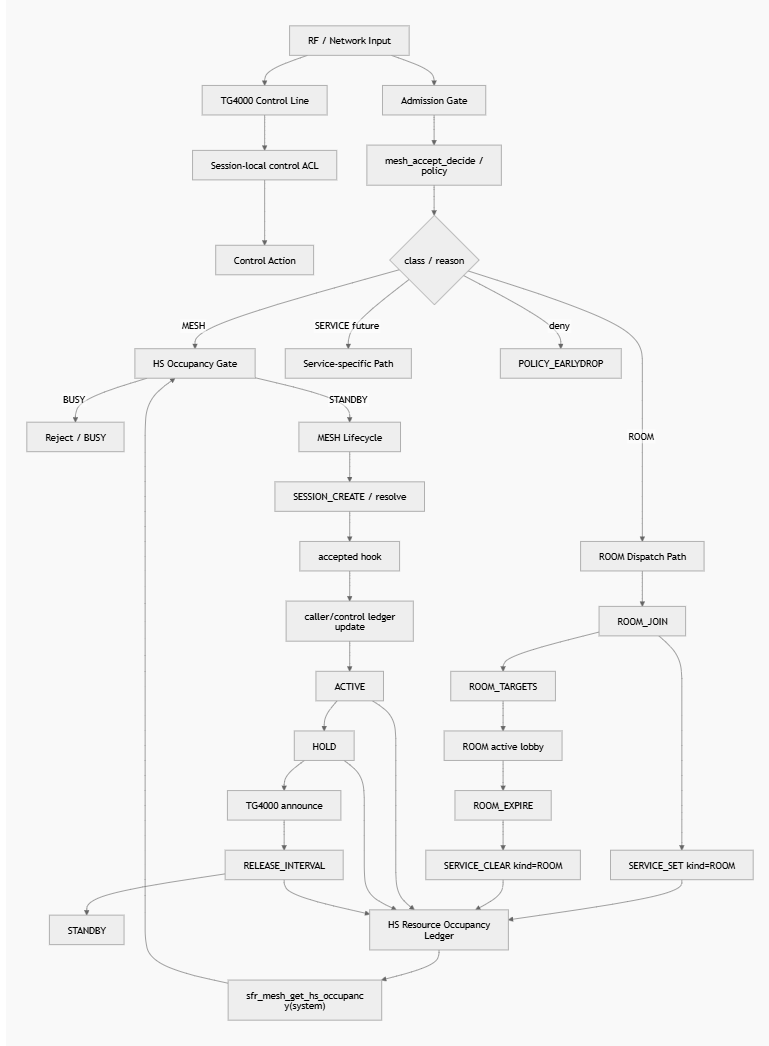
SFR-Mesh/Room TG/Service TG 通信系統判定プロセス
TG1リライトによるシンプルな運用
各ホットスポットでは、割り当てられたTGをTG1(SFRで一般的に使用されるTG番号)へリライトすることができます。
これにより次のような運用が可能になります。
-
他のSFRを呼び出すときは Manual Group ID入力でセッションを確立
-
通話開始後は TG1で会話を継続
-
ターゲットSFRの利用者は TG1設定のままで応答可能
-
そのSFRを受信しているすべての局が復調可能
この仕組みにより、利用者は複雑な操作を行うことなく自然な通話を行うことができます。
セッションの終了
通話セッションは永久に維持されるわけではありません。
SFR-Meshでは、最後の送信から 30秒間音声が無い場合、セッションは自動的に終了します。
また、必要に応じて 手動による強制終了も可能です。
これにより、SFRリソースは常に解放され、ネットワークの効率的な運用が保たれます。
SFRの接続に関して
現在開発中につき実験段階です。 現時点では小さな規模になりますがVoIPリンク研究会のご協力を頂きまして実験運用を強います。
このシステムはSFRをVoIP接続するインフラを提供することを最大の目的とし開発されました。 したがってSFR接続目的ではないプライベートのHSを直接接続することを主な目的としておりません。
また、SFR側のHSをシステムの一部として制御を分散して運用する都合上、設定ミスなどによりシステム全体に影響を及ぼす可能性が高いセンシティブな状態です。 将来有線接続方式のNodeは開発中でSFRと併用でパブリックNodeをSFR-Meshに拙臆することは計画しております。
各SFR基地局でのHSの設置・運用に関しましては、それぞれのSFR管理者の責任においてお願いいたします。 SFR-Meshはインフラ提供を目的としたシステムリソースであり、SFR基地局設備の運用管理を負うものではありません。
DMR以外のモードの接続について
様々な制御をETSIに準拠して構築していますのでDMR専用のシステムです。 フレームレベルで関与していますので、DMRプロトコル以外のモードでの相互運用は制御インタープリターのような機構が必須で現時点ではその開発の可能性は非現実的と認識しています。 Static TG接続れべるが現実的なラインと考えています。
一方で、Open Bridge Protocol (OBP)を実装し既存のADNシステムとの外部相互接続の互換性は維持していますので将来の展開は可能です。
また、D-APRSのモジュール実装も計画しております。
日本特有のシステム?
ではありません。
ガラパゴスシステムか?と言われる場面や方々もあるかと想像しますが、ETSIに準拠して開発を進めることによりシステムとしてガラパゴス仕様だは無く、また、ならないように注意していきます。
SFR-Meshは現在Simplex Modeを基準に開発していますが将来的にはDuplex Modeを追加することにより通常型DMRレピーター基地局に対応も可能です。 これによりTG接続の為レソースが天佑される仕組みの改善になりリソースを動的に割り当てることが可能になります。 周波数コントロールを除いてトランキングに近い効率の良い運用が可能になると思われます。
昨今のアマチュア無線の分野におけるFRの普及は日本特有のものであることは事実です。 日本以外ではロシアにおいて一定の業務用SFRの需要はありますが特殊な状況です。
せっかく普及したSFRを相互にフレキシブルに、オープンに接続することでHot Spotをお持ちでないユーザーでも気軽にネット接続が楽しめる利便性向上を目標に、DMRを通じてアマチュア無線で楽しい時間を共有して頂くのが開発者の最大の願いです。 そこで今この環境であったら良いなと思うシステムを作ることが願いです。
現在の日本国内のアマチュア無線をとりまく環境ではSFR接続が選択肢となっていますので、そのさらなる普及に寄与できれば有難いです。
システムについて
SFR-Meshシステムは7K2LGO 佐藤個人により独自に制作し、現在自身のサーバーにて稼働しております。 プログラムはまだまだ発展途上でありバグや不具合があり改善の余地がある状態ですので、今後実証実験を通じてできる範囲で改善していきます。
開発に際してシステム設計とプログラム製作・実装は私一人で作業を行っておりますが、その際に必須となる運用テストはVoIPリンク研究会の皆様のご協力と応援を頂き、お陰でここまでたどり着けました。
既存のADNシステムのコアをベースに互換性をある程度維持しつつ、主要なモジュールは新規に開発しています。
実際にはコア部分御90%を変更または追加実装し、Commonモジュール群を新規に作成して新しい制御レイヤーを実現しています。 もともとはシングルセッションベースでTG空のan-Outが基本理念のコアから、Fan-Outを極力抑制して綿密にコントロールしさらにシングルセッションからマルチセッション制御を行っていますのでほぼ別物になっています。
Dashboardは現在ADN用のものを一部修正して稼働していますが今後マルチセッションに適したインターフェースや情報を見れるように改善予定です。
ある程度開発が進み実用に耐えることが分かりましたら公開いたします。 現時点では公開に堪えない状態です。 またベースとなっているサーバープログラム自体のインストール作業を含めた再現性が著しく悪く公開してもなかなか稼働に至るまでが困難なところも事実です。
SFR-Mesh
SFR-Mesh is a new network architecture that connects multiple SFRs (Single Frequency Repeaters) in a mesh topology and dynamically forms communication sessions.
The system is currently under development, and field experiments began in March 2026.
What is SFR-Mesh?
SFR-Mesh introduces a newly developed upper-layer TG control mechanism called LUTG. It redefines the role of conventional Talk Groups from simple distribution destinations into session-creation triggers. By doing so, TG control—traditionally centralized—is distributed to individual SFR (Single Frequency Repeater) nodes, enabling the dynamic formation of mesh-connected communication sessions.
In conventional DMR networks, voice communication is primarily distributed based on fixed Talk Groups (TG).
When a user presses the PTT (Push-to-Talk) button, the voice stream is transmitted to all nodes connected to that TG.
This method is simple and widely used, but it introduces several limitations in an SFR environment.
In conventional operation, a Talk Group (TG) connection must remain active. Because an SFR is a single-channel resource, maintaining this connection effectively keeps the channel permanently engaged, occupying the SFR’s limited capacity. Furthermore, while connected, local traffic is automatically forwarded to the network, which can create operational issues for publicly shared SFR stations.
In a small private hotspot environment this may not be a major issue, but in the SFR (DMR Digipeater) systems currently deployed in Japan, several operational constraints arise.
Limitations of the Conventional Method
When using traditional TG-based distribution:
-
SFR resources remain occupied while connected to a TG
-
The available TG range becomes restricted
-
Voice traffic is delivered to unnecessary nodes
-
Communication requires multiple stations to be present on the same TG
In typical overseas DMR repeaters (uplink/downlink dual-frequency systems), flexibility is achieved by operating multiple TGs simultaneously using two Time Slots.
However, SFR (Single Frequency Repeater) systems widely used in Japan operate on a single-channel architecture, which imposes stricter limitations on TG-based operation.
The most significant limitation is:
Communication cannot be established at arbitrary times unless the destination SFR is already connected to the same TG.
The Concept of SFR-Mesh
SFR-Mesh introduces a different approach to communication.
Instead of treating communication as a simple TG distribution, calls are managed as sessions.
When a user presses PTT, the call is handled as a communication session formed between specific nodes, rather than a broadcast to a TG.
This mechanism enables:
-
Voice delivery only to required nodes
-
Minimization of SFR resource occupation
-
Multiple simultaneous conversations
LUTG (Logical Unified Talk Group)
SFR-Mesh does not completely replace traditional TGs.
Instead, TGs are used as triggers, while a new logical layer is introduced.
This layer uses LUTG (Logical Unified Talk Group).
LUTG is an internal TG dynamically assigned per session, responsible for controlling call routing.
When a connection request occurs, only the relevant SFR nodes are connected using a peer-to-peer link.
This approach allows the system to:
-
Eliminate unnecessary permanent connections
-
Create communication paths only when required
Mesh-Based Call Sessions
In SFR-Mesh, each call is treated as a pair consisting of:
-
origin
-
target
Example:
target = TG711108
Once this pair is established, the system generates:
-
a Session ID (msid)
-
a LUTG
Example:
LUTG = 805001
msid = 3
origin = 711111
target = 711108
Each session is managed independently and completely isolated from other sessions.
For example, the following simultaneous calls may exist:
LUTG=805002 Origin:711112 ↔ Target:711109
LUTG=805003 Origin:711112 ↔ Target:711025
This means multiple voice sessions can operate simultaneously within the network.
Voice distribution is fan-out only within the Origin/Target pair.
SFR-Mesh/Room TG/Service TG Stream Lines Stracture
Simplified Operation Using TG1 Rewrite
Each hotspot can rewrite the assigned TG to TG1, which is commonly used in SFR environments.
This enables the following operational flow:
-
Establish a session using manual Group ID input
-
Continue the conversation on TG1 after the session begins
-
Users on the target SFR can respond while remaining on TG1
-
All stations receiving that SFR transmission can demodulate the call
This allows users to communicate naturally without complex operations.
Session Termination
Call sessions are not maintained indefinitely.
In SFR-Mesh, if no transmission occurs for 30 seconds after the last voice frame, the session automatically terminates.
Sessions can also be manually terminated when necessary.
This mechanism ensures that SFR resources are always released and the network operates efficiently.
Regarding SFR Connections
The system is currently in an experimental phase.
Initial experimental operation is conducted on a small scale with the cooperation of the VoIP Link Research Group.
The primary purpose of this system is to provide infrastructure for VoIP connectivity between SFR stations.
Therefore, it is not primarily intended to connect private hotspots directly when they are not part of an SFR station.
Since the SFR-side hotspots operate as distributed components of the system, configuration errors may affect the entire network.
Future development includes wired connection nodes, which will allow public nodes to be connected to SFR-Mesh in combination with SFR stations.
Operation and installation of hotspots at each SFR station remain the responsibility of the respective SFR operators.
SFR-Mesh provides infrastructure resources and does not assume operational responsibility for SFR station equipment.
Interconnection with Non-DMR Modes
SFR-Mesh is designed strictly in compliance with ETSI specifications and therefore operates as a DMR-specific system.
Because the system interacts at the frame level, interoperability with other digital voice modes would require a protocol interpreter or gateway mechanism.
At present, developing such a system is considered impractical.
The realistic interoperability approach is at the static TG connection level.
However, SFR-Mesh implements Open Bridge Protocol (OBP), maintaining compatibility with existing ADN systems, allowing potential future expansion.
A D-APRS module is also planned.
Is This a Japan-Specific System?
No.
Some may wonder whether this is a “Galápagos-style” system unique to Japan.
However, the system is being developed in strict accordance with ETSI standards, ensuring that it does not become a proprietary or isolated implementation.
SFR-Mesh is currently designed for simplex operation, but future development will support duplex repeaters, enabling operation on conventional DMR repeater infrastructure.
This would improve the inefficiency of static TG connections and allow dynamic resource allocation, potentially achieving operational efficiency similar to trunking systems (excluding frequency control).
While the widespread use of SFR in amateur radio is somewhat unique to Japan, similar professional SFR use cases exist in regions such as Russia.
By enabling flexible and open interconnection between SFR stations, SFR-Mesh aims to improve accessibility so that even users without personal hotspots can enjoy network connectivity.
The developer’s goal is to allow amateur radio operators to share enjoyable communication experiences through DMR.
Given the current regulatory and operational environment in Japan, SFR connectivity represents a practical solution, and contributing to its wider adoption would be greatly appreciated.
About the System
The SFR-Mesh system was independently developed by Takahisa Sato (7K2LGO) and currently operates on his personal server.
The software is still under active development and may contain bugs or incomplete features. Improvements will continue through ongoing experimental operation.
While the system architecture, programming, and implementation have been carried out individually by the developer, operational testing has been made possible through the invaluable cooperation of Ichikawa (JF1UVG) from the VoIP Link Research Group.
His continuous support and testing efforts have been essential in bringing the project to its current stage.